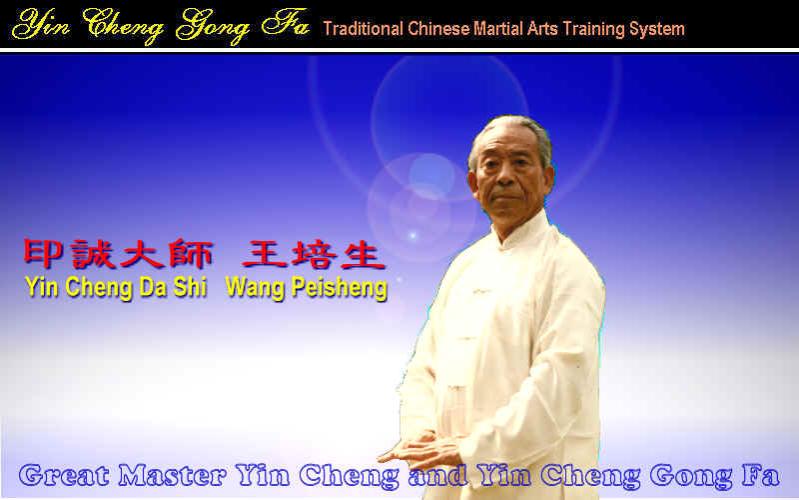
Great Master Yin Cheng -- Wang Peisheng
YIN CHENG is Grand Master Wang Peisheng's Fa-Hao. By tradition many Chinese use one or more
particular names for a special reason. These names are called Hao - "literature name". Each Hao has a
special meaning. For example, it might signify a person's favorite thing, a dream, faith, hope, goal in life,
feeling in the heart and mind, or a personality characteristic. Usually people give a Hao to themselves.
Sometimes a Hao is given to a person as a gift by a famous or special person. In some special groups,
like the Taoist, Buddhist, or martial arts families, Hao is also called Fa-Hao. Here Fa means "special
power." Usually, masters give their disciples a Fa-Hao when they join the group. It has always been an
expression and desire of the master for the disciple.
particular names for a special reason. These names are called Hao - "literature name". Each Hao has a
special meaning. For example, it might signify a person's favorite thing, a dream, faith, hope, goal in life,
feeling in the heart and mind, or a personality characteristic. Usually people give a Hao to themselves.
Sometimes a Hao is given to a person as a gift by a famous or special person. In some special groups,
like the Taoist, Buddhist, or martial arts families, Hao is also called Fa-Hao. Here Fa means "special
power." Usually, masters give their disciples a Fa-Hao when they join the group. It has always been an
expression and desire of the master for the disciple.
Because of his great gongfu skills, Master Wang is generally recognized as Da Shi. Da means great,
grand, or prominent, and Shi means teacher, shifu, or master. Therefore Dai Shi is a master who is
recognized as an exceptionally accomplished martial artist. Although only a few people had known
Master Wang's Fa-Hao, he made it public at his seventieth birthday celebration. From that point on, he
has been called YIN CHENG DA SHI as a sign of respect for his great skill and learning.
grand, or prominent, and Shi means teacher, shifu, or master. Therefore Dai Shi is a master who is
recognized as an exceptionally accomplished martial artist. Although only a few people had known
Master Wang's Fa-Hao, he made it public at his seventieth birthday celebration. From that point on, he
has been called YIN CHENG DA SHI as a sign of respect for his great skill and learning.
In Chinese, YIN means printing, seal, impression, and credit. CHENG means honesty, sincerity,
genuineness and good faith. Master Wang always says: "You have two lives. One is your physical life,
the other is your honesty, and the last is more important than the first. If you are not honest, you are
dead even though your body may still breathe. If your honesty is everlasting, you live forever even
though your body has died." This adage expresses the real meaning of YIN CHENG.
genuineness and good faith. Master Wang always says: "You have two lives. One is your physical life,
the other is your honesty, and the last is more important than the first. If you are not honest, you are
dead even though your body may still breathe. If your honesty is everlasting, you live forever even
though your body has died." This adage expresses the real meaning of YIN CHENG.
Today, Master Wang holds many official positions. He is president of the Yin Cheng Gong Fa
Association and of the Beijing Wu Style Taiji Quan Association; director of the Physical Science
Research Center of BITI; expert committee member of the China Human-Body Science Institute;
professor at the Chinese Qigong Institute for Advanced Studies; professor at the Beijing Normal College;
and a consultant for martial arts and Qigong associations in many cities and provinces. Formerly, he was
president of the Orient Martial Arts School; president of the Peisheng Martial Arts School; chairman of
the Mass Martial Arts Club and director of the Huitong Martial Arts School. Master Wang has also held a
variety of teaching and martial arts coaching posts at Beijing Normal University, Beijing Foreign
Language University, Beijing Language Institute, Beijing Industry College, Beijing Polytechnic University,
Beijing Agriculture Mechanization College, North Traffic University, China Science Institute, Tianjing
Medical College, Beijing Medical College, Beijing Workers Sanatorium, Beijing Modern Management
College, China Qigong Institute, Beijing Library, China Daily Press, National Education Committee, and
Beijing Taimiao Taiji Quan Association among others. The Chinese government regularly appoints
Master Wang as a judge and member of the Arbitration Committee of the National Martial Arts
Tournament.
Association and of the Beijing Wu Style Taiji Quan Association; director of the Physical Science
Research Center of BITI; expert committee member of the China Human-Body Science Institute;
professor at the Chinese Qigong Institute for Advanced Studies; professor at the Beijing Normal College;
and a consultant for martial arts and Qigong associations in many cities and provinces. Formerly, he was
president of the Orient Martial Arts School; president of the Peisheng Martial Arts School; chairman of
the Mass Martial Arts Club and director of the Huitong Martial Arts School. Master Wang has also held a
variety of teaching and martial arts coaching posts at Beijing Normal University, Beijing Foreign
Language University, Beijing Language Institute, Beijing Industry College, Beijing Polytechnic University,
Beijing Agriculture Mechanization College, North Traffic University, China Science Institute, Tianjing
Medical College, Beijing Medical College, Beijing Workers Sanatorium, Beijing Modern Management
College, China Qigong Institute, Beijing Library, China Daily Press, National Education Committee, and
Beijing Taimiao Taiji Quan Association among others. The Chinese government regularly appoints
Master Wang as a judge and member of the Arbitration Committee of the National Martial Arts
Tournament.
Master Wang passed away on
Sept 3, 2004. Below article was
published on Taichi Magazine
for remembering him
Sept 3, 2004. Below article was
published on Taichi Magazine
for remembering him
| Remembering Great Master Wang Peisheng by Zhang Yun |
| The Road of Master Wang's Martial Arts Training |
| Grand Master Wang Peisheng is president of the Beijing Wu Style Taiji Quan Association and one of the most outstanding martial arts masters in China. He started practicing martial arts when he was twelve years old and went on to study with some of the most famous masters in China. He studied Yin Style Bagua Zhang with Ma Gui, Jiao-men Tantui with Zhang Yulian, Wu Style Taiji Quan with Yang Yuting and then received special intensive training from his grandmaster Wang Maozhai (who was the number one Taiji master in north China at that time). He also mastered: Cheng and Liu Style Bagua Zhang with Gao Kexing; Ruyi Tongbei Quan with Liang Junbo; Shanxi Xingyi Quan with Zhao Runting; Hebei Xingyi Quan and Bagua Zhang with Han Muxia; Baji Quan with Wu Xiufeng; Buddhist philosophy and Qigong system with Liao Yi and Miao Chan; Taoist philosophy and Qigong system with Shen Xingchan and Wu Jinyong; and Confucianism with Jin Hu and Xu Zhenkuan. Additionally, he studied Shaolin Quan, Chinese wrestling, several Qigong systems and Chinese medicine. His training in all of these disciplines was intensive, rigorous and professional, and his training sessions often lasted all day. By eighteen years of age, he had become the youngest professional martial arts master in Beijing. Throughout his life, he defeated many famous masters, giving him the reputation of a great master of real fighting techniques. Grand Master Wang is also a scholar of traditional Chinese arts, philosophy, and culture. |
Grand Master Wang has spent his whole life researching the martial arts. He became good friends with
many masters and researched many concepts and techniques with them. Thus, his knowledge of martial
arts spans a wide variety of styles. Because of this, he is able to look at many different styles and
understand the true nature and essence of the martial arts. He is not a conservative teacher who believes
in only one method and just stays in a rut. He has developed his own system without excluding traditional
rules. He does not accept anything as true until he knows it to be correct from his own experience and
research. He does not say or teach anything before he really can do it. He always asks himself and other
people "why?" He respects and follows tradition but never rejects progress. He creates new approaches
but never without thought. He practices hard, studies everything without prejudice and thinks deeply, so
that he receives and inherits the essence of traditional martial arts. He sums up the experience of the
older generations, analyzes everything in detail and develops his new system based on the traditional
system. Today, people respect him not only for his skills, but also for his high level martial arts ideas and
new training methods.
many masters and researched many concepts and techniques with them. Thus, his knowledge of martial
arts spans a wide variety of styles. Because of this, he is able to look at many different styles and
understand the true nature and essence of the martial arts. He is not a conservative teacher who believes
in only one method and just stays in a rut. He has developed his own system without excluding traditional
rules. He does not accept anything as true until he knows it to be correct from his own experience and
research. He does not say or teach anything before he really can do it. He always asks himself and other
people "why?" He respects and follows tradition but never rejects progress. He creates new approaches
but never without thought. He practices hard, studies everything without prejudice and thinks deeply, so
that he receives and inherits the essence of traditional martial arts. He sums up the experience of the
older generations, analyzes everything in detail and develops his new system based on the traditional
system. Today, people respect him not only for his skills, but also for his high level martial arts ideas and
new training methods.
______________________________________________________________________________________________________________


| The Poem of Yin Cheng Gong Fa |


______________________________________________________________________________________________________________
Yin Cheng Gong Fa
Grand Master Wang Peisheng studied traditional martial arts with many famous masters. During his seventy
years of studying, practicing and teaching, he has gained superior skill in many different styles and has
developed his own martial arts training system. In Chinese, Gong means gongfu (kungfu), martial arts, or
anything that takes time to practice. Fa means Tao, method, system, way, path, or style. Gong Fa, therefore,
means a method or system for the study of martial arts. The martial arts training system developed by
Master Wang, whose Fa-Hao is Yin Cheng, is known as Yin Cheng Gong Fa (YCGF).
years of studying, practicing and teaching, he has gained superior skill in many different styles and has
developed his own martial arts training system. In Chinese, Gong means gongfu (kungfu), martial arts, or
anything that takes time to practice. Fa means Tao, method, system, way, path, or style. Gong Fa, therefore,
means a method or system for the study of martial arts. The martial arts training system developed by
Master Wang, whose Fa-Hao is Yin Cheng, is known as Yin Cheng Gong Fa (YCGF).
YCGF is founded on a very strong system of principles. It is rooted in traditional Chinese culture, including
Chinese philosophy, art, military strategy and tactics, and medical theory, and it incorporates all traditional
Chinese martial arts principles. It uses a high level view to analyze the true nature and essence of the
martial arts so that this understanding becomes more accessible to practitioners of all skill levels and can
function as an effective guide towards high level practice.
Chinese philosophy, art, military strategy and tactics, and medical theory, and it incorporates all traditional
Chinese martial arts principles. It uses a high level view to analyze the true nature and essence of the
martial arts so that this understanding becomes more accessible to practitioners of all skill levels and can
function as an effective guide towards high level practice.
YCGF also includes many useful techniques. It offers people the choice of different paths to high level
accomplishment. But Yin Cheng Gong Fa is not just a mix of different styles simply put together. Rather, it
inherits, summarizes, and develops many traditional systems. It utilizes all traditional methods but breaks old
conservative ideas and uses higher level principles to consider the martial arts. It encompasses, absorbs and
summarizes good ideas from many traditional systems.
accomplishment. But Yin Cheng Gong Fa is not just a mix of different styles simply put together. Rather, it
inherits, summarizes, and develops many traditional systems. It utilizes all traditional methods but breaks old
conservative ideas and uses higher level principles to consider the martial arts. It encompasses, absorbs and
summarizes good ideas from many traditional systems.
When people start to practice YCGF, they will be trained in very traditional methods first. Everything is pure;
nothing is changed. It is our desire to transmit traditional skills which were developed and elaborated upon
by many generations of martial arts masters. This is the first step and cannot be skipped. One can further
the development of a system only after he has understood it, and one must be able to understand
traditional ideas, before he can understand Yin Cheng Gong Fa.
nothing is changed. It is our desire to transmit traditional skills which were developed and elaborated upon
by many generations of martial arts masters. This is the first step and cannot be skipped. One can further
the development of a system only after he has understood it, and one must be able to understand
traditional ideas, before he can understand Yin Cheng Gong Fa.
| YCGF is not a conservative, exclusive, or isolated system. It is not designed in opposition to other systems or styles. One can continue his practice of a former style when he trains in Yin Cheng Gong Fa. Experience has shown that this system can be used to help improve the application of techniques from other styles. |
In this system, people get intensive training in one or two styles first, but they are not limited to these. This
system will always give one a high level view of principles not just familiarity with techniques. From their
training, people are gradually guided towards an understanding of the truly high level nature and essence of
the martial arts.
system will always give one a high level view of principles not just familiarity with techniques. From their
training, people are gradually guided towards an understanding of the truly high level nature and essence of
the martial arts.
To study Yin Cheng Gong Fa is not an easy task because high level achievement requires a lot of hard
work. We cannot guarantee that everyone will develop high level skill, but we are sure people can improve
their chances for high level mastery. This system will help people develop a correct understanding of the
martial arts.
work. We cannot guarantee that everyone will develop high level skill, but we are sure people can improve
their chances for high level mastery. This system will help people develop a correct understanding of the
martial arts.
The Path of Yin Cheng Gong Fa Development
It took a long time to develop this system. It is typically
dated from Master Wang's creation of the Wu Style Taiji
Quan Thirty-seven Posture Form in 1953. The system was
not popular during the 1960's and 70's because of political
conditions in China at that time. Nevertheless, it did spread
quietly during this period. When Master Wang returned to
Beijing in the 1980's and rebuilt his reputation, the system
spread widely. It quickly became popular and famous in
China. At that time, after years of thought and careful
organization, Master Wang published his new training style
Qian Kuan Wu Ji Gong, which combined many high level
martial arts and Qigong skills. We think the time is ripe to
present this new martial arts training system. In 1987,
Master Wang decided to use his special literature name Yin
Cheng to name the new system, so it was then that Yin
Cheng Gong Fa was born.
dated from Master Wang's creation of the Wu Style Taiji
Quan Thirty-seven Posture Form in 1953. The system was
not popular during the 1960's and 70's because of political
conditions in China at that time. Nevertheless, it did spread
quietly during this period. When Master Wang returned to
Beijing in the 1980's and rebuilt his reputation, the system
spread widely. It quickly became popular and famous in
China. At that time, after years of thought and careful
organization, Master Wang published his new training style
Qian Kuan Wu Ji Gong, which combined many high level
martial arts and Qigong skills. We think the time is ripe to
present this new martial arts training system. In 1987,
Master Wang decided to use his special literature name Yin
Cheng to name the new system, so it was then that Yin
Cheng Gong Fa was born.

| "Yin Cheng Tang" - written by the famous calligraphy master Xiao Lao (92 years old) for Grand Master Wang's seventieth birthday ceremony. |
| Picture Gallery - Yin Cheng Tang |
| Remembering Great Master Wang Peisheng by Zhang Yun |
 | |  | |  | |  | |  | |  | |  |
 | |  | |  | |  | |  | |  | |  |
Yin Cheng Gong Fa Association North American Headquarters
Copyright © 2000 YCGF_NAH. All rights reserved.
______________________________________________________________________________________________________________
______________________________________________________________________________________________________________
 |
| |
 |
| |
 |
| |
 |
| |
 |
| |
 |
| |
 |
| |
 |
| |
 |
| |
 |
| |
 |
| |
 |
| |
 |
| |
 |